
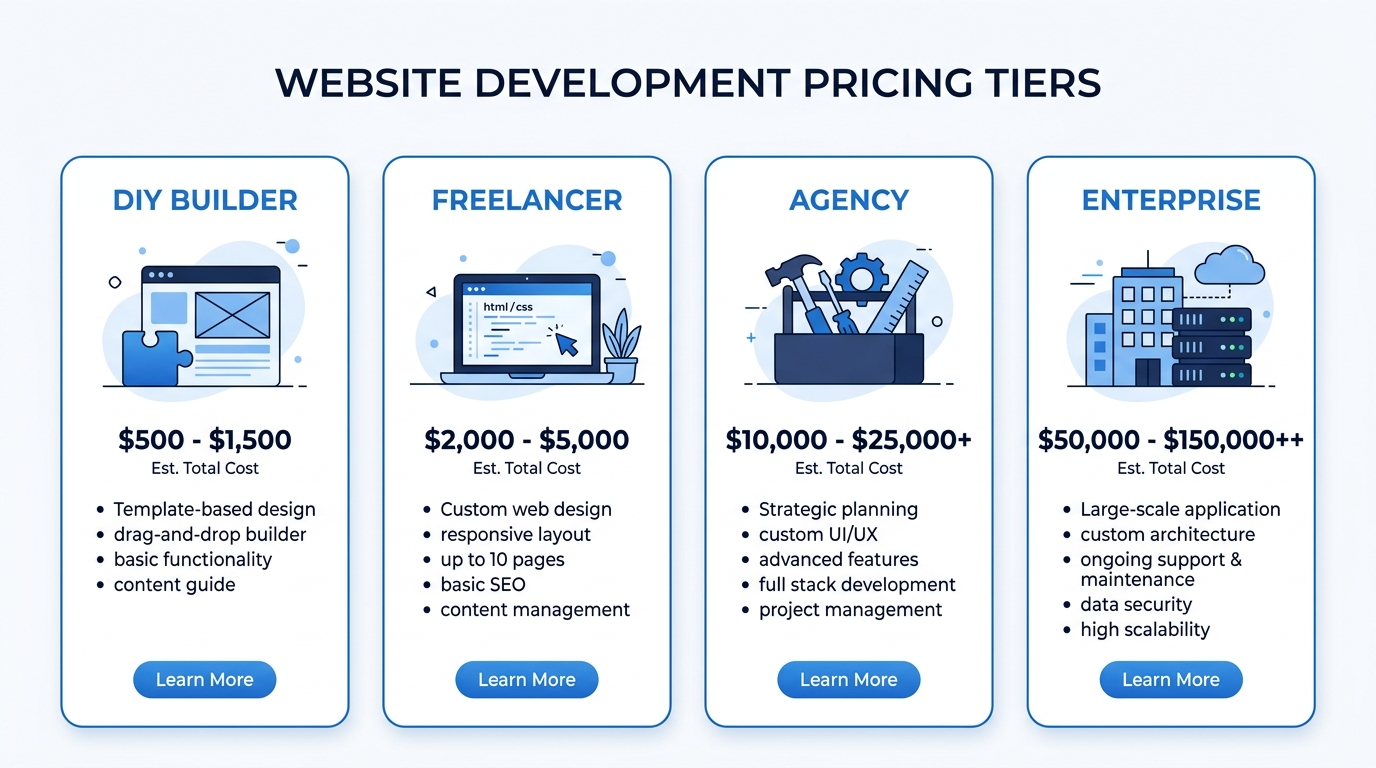
A business website in 2026 can cost anywhere from $0 to $50,000+, and that's not a cop-out answer — it's the reality of a market where a DIY builder, a freelancer on Fiverr, and a development agency are all technically selling "a website" but delivering completely different things.
Most people asking this question aren't looking for a single number. They're trying to figure out if the $300 quote they got is too good to be true, or if the $8,000 proposal is a rip-off. So instead of throwing out a fake "starting from $X" figure, here's what websites actually cost by category, what changes the price, and how to know which tier your business actually needs.
The Honest Answer: Price Ranges by Website Type
DIY Website Builders — $0 to $50/month
Platforms like Wix, Squarespace, or Shopify let you build a site yourself using templates. You're paying for the platform subscription, not custom development. This works for a very simple online presence — a menu, a portfolio, basic contact info — but you're limited to what the template allows, and it rarely looks distinct from thousands of other businesses using the same theme.
Freelance Developer — $300 to $3,000
A freelancer builds something more tailored, usually working alone. Price depends heavily on their experience and location. The catch: quality varies enormously, timelines can slip since it's one person juggling multiple clients, and post-launch support is often informal or nonexistent once they've moved to the next project.
Small Agency (Custom Build) — $1,500 to $10,000
An agency-built site usually means custom website development — not a stock template — proper functionality planning, testing across devices, and some structure around revisions and support. This is where most growing small-to-mid businesses land, because it balances real quality with a budget that isn't enterprise-level.
Enterprise / Large-Scale Platforms — $10,000 to $50,000+
Large e-commerce stores, custom web applications, or platforms needing heavy backend logic — like a CRM built into your website or a booking system — fall here. This isn't "a website" in the brochure sense — it's closer to software development.
What Actually Drives the Price Up or Down
The type of website only tells part of the story. Within each tier, these factors move the number a lot:
- Number of pages and custom functionality — a 5-page brochure site and a 30-page site with a booking calculator are not the same job, even if both are "just a website."
- Design: template vs. custom — a customized template is faster and cheaper; a fully custom design built around your brand takes more design hours.
- E-commerce or booking systems — payment integration, inventory logic, or appointment scheduling adds real development time, not just a plugin.
- Content and copywriting — if the client wants the agency to also write the copy, that's a separate skill and cost, often overlooked in quotes.
- Ongoing maintenance and hosting — a site isn't a one-time purchase. Updates, security patches, and hosting are recurring costs most people forget to ask about upfront.
Why Two "Same" Websites Can Cost So Differently
The freelancer discount trap
A $300 website and an $8,000 website can look similar in a screenshot. The difference shows up later — in load speed, mobile responsiveness, how easily it can be updated, whether it's actually optimized to convert visitors into leads, and whether anyone answers if something breaks in six months.
What agencies charge for that you don't see
Agency pricing usually includes project management, QA testing, a proper development process, and support after launch — none of which show up in the final product visually, but all of which affect whether the site keeps working and converting a year from now. For example, our case study on Azam Travel & Tours shows what a custom-built booking/calculator system actually looks like once it's live.
Hidden Costs People Forget to Budget For
- Domain registration (~$10–20/year)
- Hosting (~$5–50/month depending on traffic and platform)
- SSL certificate (often included free with modern hosting, but worth confirming)
- Stock photography or custom photography
- Ongoing content updates
- Third-party tool subscriptions (booking systems, email marketing integrations, etc.)
How to Know What You Actually Need
Before requesting quotes, get clear answers to:
- Is this a simple informational site, or does it need to actually sell something / take bookings?
- Who is updating the content after launch you, or the developer?
- Do you need it to rank on Google, or is traffic coming from ads and referrals?
- What's the realistic timeline is this urgent or can it be built properly over a few weeks?
Answering these honestly narrows the price range fast, because most quote confusion comes from comparing apples to oranges — a template site quote against a custom-build quote.
When It Makes Sense to Invest More
If the website is meant to be a serious lead-generation or sales tool — not just a digital business card — the cheaper tiers usually cost more in the long run, through lost leads, slow load times, or a redesign a year later. A custom-built site designed around how customers actually make buying decisions tends to pay for itself faster than it looks on the initial invoice.
If you're at the stage of comparing quotes and want a second opinion on whether one is fair for what it includes, that's a conversation worth having before signing anything — get in touch with Dev AT Solutions and we'll tell you straight, even if the answer is "you don't need what they're selling you."
FAQ Section
How much should a small business budget for a website in 2026?
Most small businesses should budget $1,500–$5,000 for a custom-built site with proper design and basic functionality. Below that, expect template-based limitations; above that, you're usually paying for e-commerce, custom features, or enterprise-level complexity.
Is a $300 website worth it?
It can work for a very basic online presence, but it usually means a template design, limited customization, and little to no ongoing support. It's a reasonable starting point, not a long-term growth tool.
Do website prices include hosting and maintenance?
Not usually. Hosting, domain renewal, and maintenance are typically separate ongoing costs — always confirm what's included in a quote and what isn't.
Why do agency quotes vary so much for the same type of website?
Because "a website" isn't standardized — the number of pages, custom functionality, design work, and post-launch support all differ between agencies, even for projects that sound identical on the surface.
Is it cheaper to hire a freelancer or an agency?
Freelancers are usually cheaper upfront, but agencies typically offer more structured process, testing, and support after launch — which matters if the site needs to keep working reliably as your business grows.